Classic Mode
Type any Pokémon name and the table compares it with the day's target column by column: types, generation, height, weight and evolution family. Green is an exact match, yellow is partial, and arrows show whether the real value is higher or lower.
Spend the first guess on information rather than on a hunch, then let the height and weight arrows close in on the answer. A new Pokémon goes up every day.
How to play
Classic Mode
- Guess any Pokémon. Each guess adds a row that compares it with today's answer.
- Green is a match, yellow is close and red is wrong; arrows say whether the answer is higher or lower.
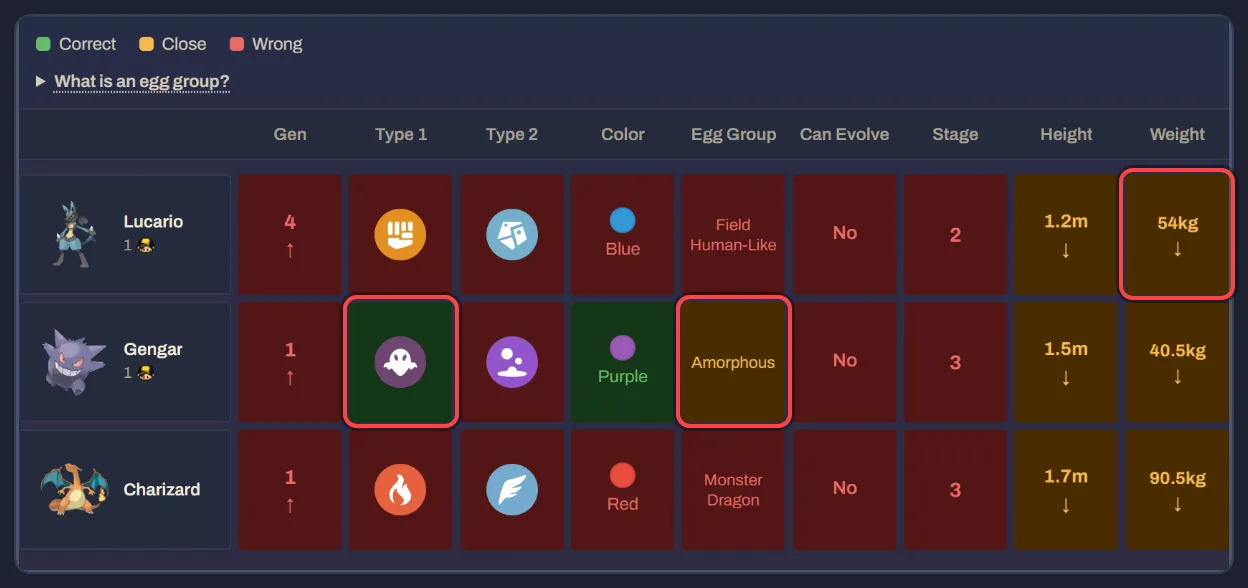
- Guesses are unlimited: use each one to rule out as much as you can until you find it.
Classic is the deduction mode: one Pokémon is the answer for the whole day, and you find it by guessing other Pokémon and reading what the table tells you about each one. Every guess is compared with the target across five columns — types, generation, height, weight and evolution family — and each column answers independently.
Nothing is hidden behind a scoring system and there is no penalty for a guess that lands nowhere. A guess that eliminates half the Pokédex is worth more than a guess that was nearly right, which is the whole reason the mode rewards a plan over a hunch.
Reading the table
Green means the column matches exactly. Yellow means it overlaps without matching: on the type column, one of the two types is right but the other is not, or the pair is right but the order is not. Red means no overlap at all.
Height and weight add an arrow. An up arrow means the answer is taller or heavier than what you guessed, a down arrow means it is shorter or lighter. Those two columns are the only ones that keep narrowing a range instead of just accepting or rejecting a value, which makes them the most useful clue late in a round.
Openings that pay
- Open with a dual-type Pokémon from a middle generation at ordinary height and weight. It splits the field on five axes at once instead of betting everything on one.
- Avoid opening with a legendary or a first-stage baby Pokémon: both sit at an extreme on most columns, so a red result tells you almost nothing.
- Once one type is green, guess a Pokémon that keeps that type and changes everything else. Re-testing a column you have already solved wastes the guess.
- When both types are locked, stop guessing on type and start bracketing with height and weight — the arrows converge fast.
- If two types come back yellow and you are sure of both, try them in the other order. Primary and secondary are separate columns.
Common mistakes
- Treating yellow on the type column as 'one type correct' when it can also mean 'both correct, wrong order'.
- Chasing the evolution family column early. It is the narrowest clue on the board and rarely fires, so it is a poor thing to aim at.
- Forgetting that height and weight are independent. A Pokémon can be taller and lighter at the same time, and that combination is itself a strong hint.
Where the numbers come from
Types, generation, height, weight and evolution lines are taken from PokeAPI, the open community database, and bundled with the site so a round runs entirely in your browser with no server call. Heights and weights are the Pokédex values, in metres and kilograms.
The Pokémon of the day is derived from the date rather than drawn at random, so everyone playing on the same calendar day gets the same answer and a shared result is comparable. It rolls over at midnight Spanish time.
FAQ
How many guesses do I get?
Unlimited. The count is kept so you can compare it with friends, but a round never locks you out.
Does the same Pokémon come back?
Not on consecutive days. The date-based formula walks the list rather than sampling it, so repeats are far apart.
PokéPuzzles is an unofficial fan project, not affiliated with or endorsed by Nintendo, Creatures, GAME FREAK or The Pokémon Company. Pokémon and its character names are trademarks of Nintendo.