Combeene
Eight Pokémon and a hexagon with a link on each side: a type, a generation, a colour, or a relation like sharing an ability or evolving the same way. Each link has to hold for the two Pokémon it joins, two Pokémon are left over, and only one placement works. Five checks, with every link turning green or red.
There is a normal chain built from the first four generations and an expert one that takes any Pokémon, every day.
How to play
Combeene
- You get eight Pokémon and a hexagon with a link on each side: six go on the corners, two are left over (in Expert, ten for seven cells, three left over). Tap a Pokémon, then the corner where it goes.
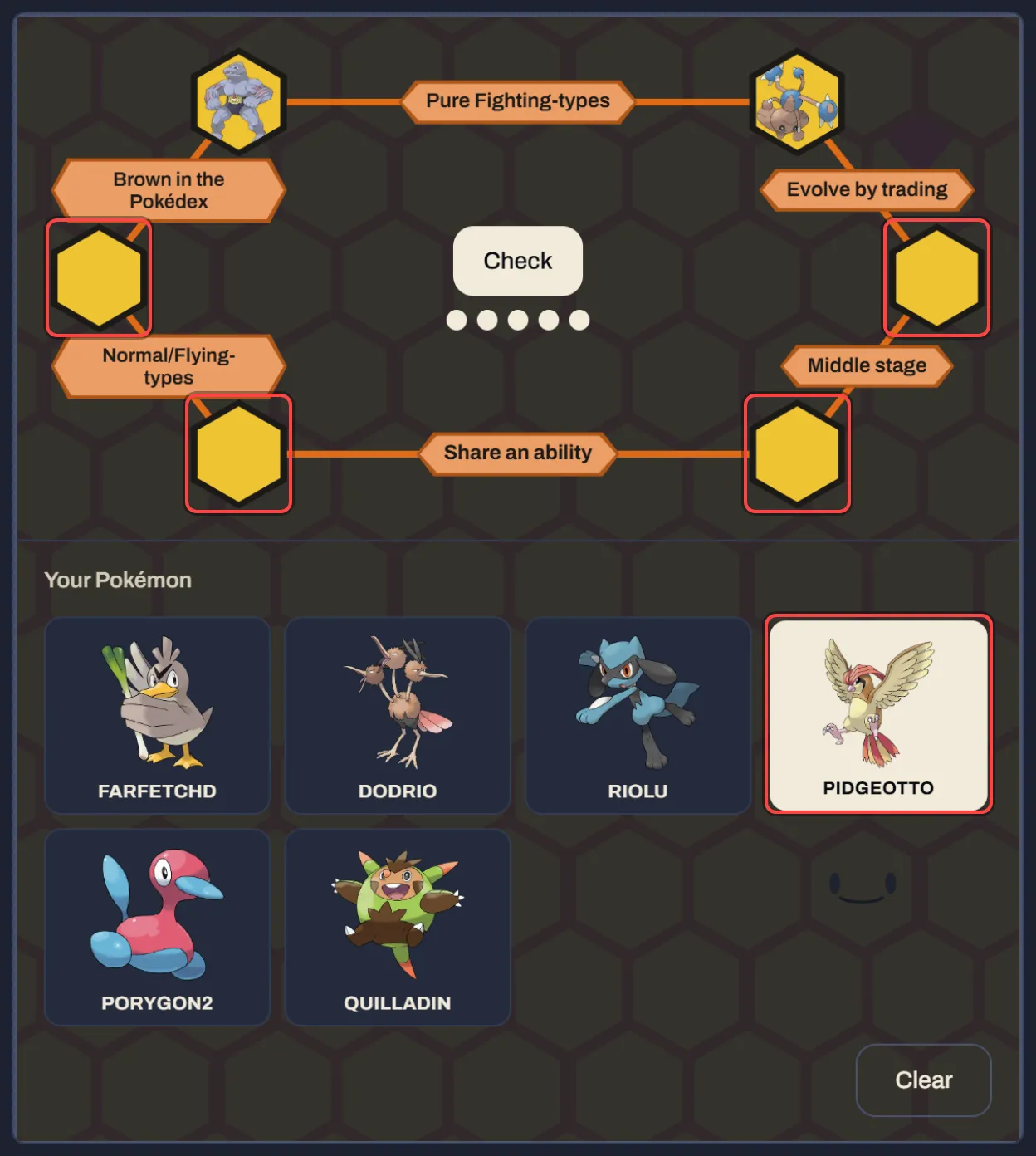
- Each link has to hold for the two Pokémon on its corners: a category both belong to, an ability they share, the same way to evolve or which of the two is from a newer generation.
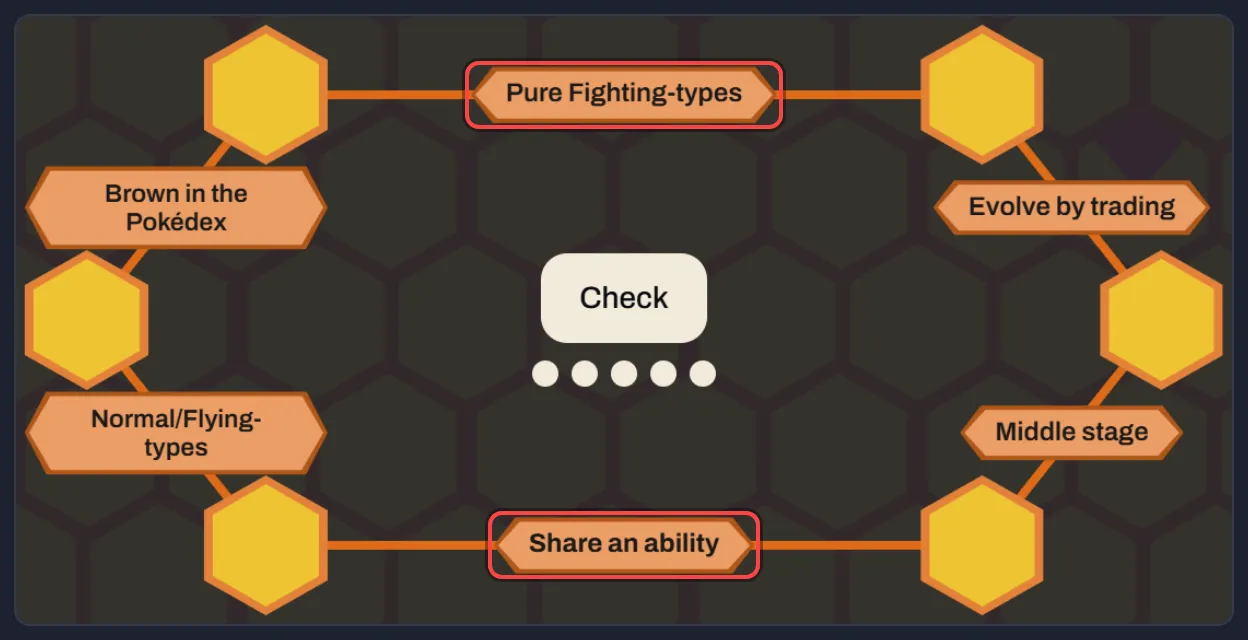
- Press Check: the links that hold turn green, the rest red. You have five checks, and there is a Normal and an Expert chain every day.
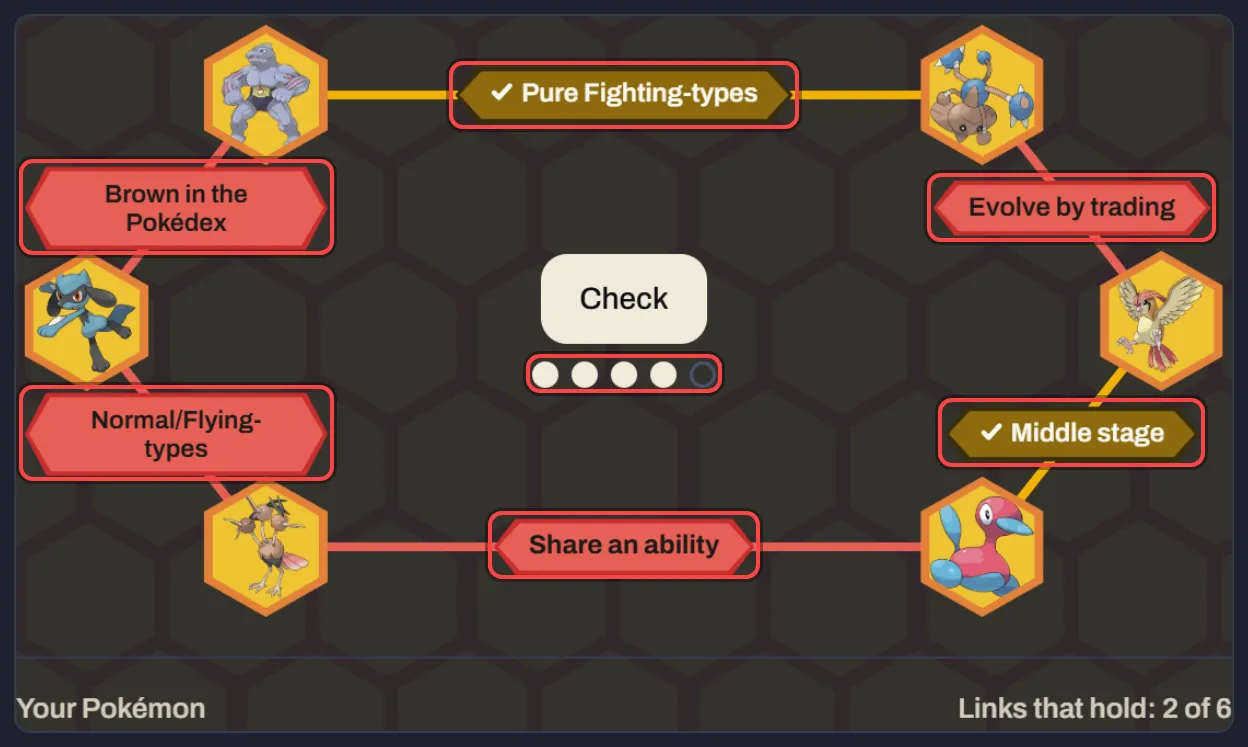
Combeene is a ring of six Pokémon on the corners of a hexagon, with a link on each of its six sides. The links are on the board from the start; eight Pokémon come shuffled in a tray, and your job is to put six of them on the corners where both links beside each one hold. The other two are decoys: each fits some of the links, but not where the ring closes.
Every link joins two corners, and the last one closes the ring onto the first, so there is no easy end to start from: begin with the narrowest link. Only one choice of six, in one placement, works.
The rules
- Tap a Pokémon in the tray, then a corner. Tap a placed Pokémon to pick it up and move it, or tap it twice to send it back to the tray.
- Check, in the middle of the hexagon, unlocks once all six corners are full. Each link turns green if it holds and red if it does not, so you know where to look.
- Checking a placement you already tried does not cost a check.
- After five checks the ring shows the answer.
The links
A category link names something both of its Pokémon have: a type, a generation, a Pokédex colour, an evolution stage, how they evolve, a Pokédex category, their catch rate, or being legendary, a starter or having a regional form. Expert leaves the obvious ones (a plain type, a colour) out.
"Share an ability" means the two have at least one ability in common, hidden abilities included. "Evolution method" means both evolve with the same stone, by trade, by friendship or by levelling up at the same time of day; plain levelling up does not count. Neither says which: once the ring is over, it shows what they had in common. "Newer generation" has an arrow: the Pokémon it points to was introduced in a later generation than the other one; the same generation does not count.
Normal and Expert
Normal uses Pokémon from the first four generations plus the starters, with one or two of those ability, evolution or generation links. Expert takes any Pokémon, harder categories and two or three of them, ten Pokémon with three left over, on a bigger piece of comb that changes every day: seven cells with the middle one wired in, so some Pokémon have three links to satisfy, some loops cross and some arms end in a dead end. Every category there fits at least three of the tiles, so no label gives its pair away. Each of those three kinds of link shows up once at most. Switch with the toggle above the board; each keeps its own progress and result.
FAQ
When is there a new chain?
Every day, at the same time as the other modes. Everyone gets the same two rings on the same day.
Can two placements both work?
No. Every ring is checked before it goes out: only one placement satisfies every link, with the decoys left out.
PokéPuzzles is an unofficial fan project, not affiliated with or endorsed by Nintendo, Creatures, GAME FREAK or The Pokémon Company. Pokémon and its character names are trademarks of Nintendo.