Palette Mode
The puzzle shows every main colour of a Pokémon's official artwork, as solid bands from head to feet, each the colour that stands out at that height, so a colour found in two places gets two bands. The palette never changes: no outline, no zoom, however many misses.
The colour that keeps coming back usually points at the type, and the bands read like a body, head at the top and feet at the bottom; the thin ones are the accents, a red cheek or a cream belly, that give the Pokémon away.
How to play
Palette Mode
- The main colours of a Kanto Pokémon, as bands from head to feet.
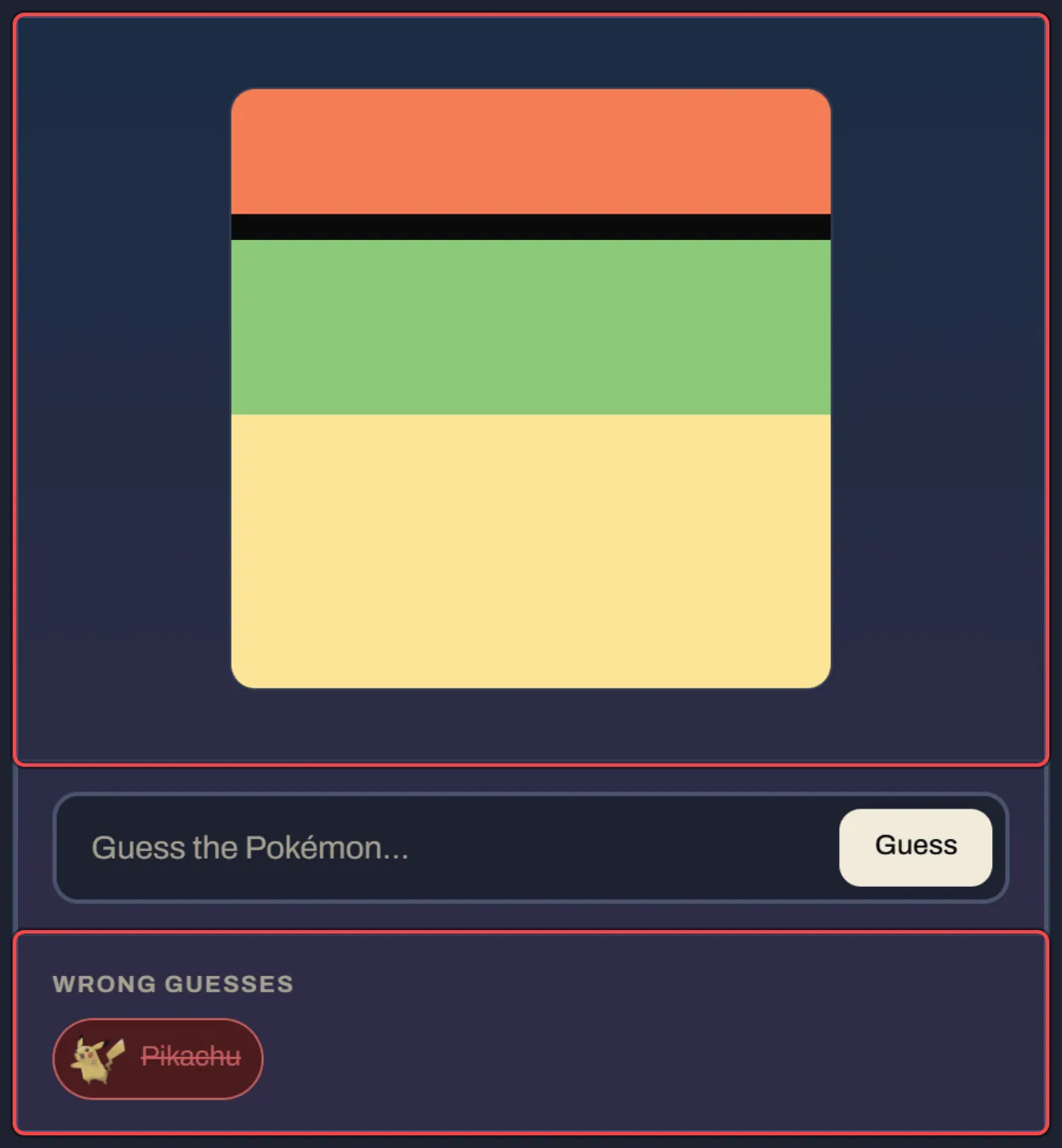
- Guess which Pokémon it is.
- The palette never changes, so every miss only adds to your count.
Palette mode shows the main colours of a Pokémon's official artwork as solid bands, read from head to feet: each band is the colour that stands out at that height of the Pokémon, and a colour found in two places gets two bands. Then it asks you to name it. The whole palette is there from the start.
That palette is the whole puzzle, and the answer is always one of the 151 Kanto Pokémon, so the guess box only offers those. The palette does not change as you miss: no extra colours, no outline, no zoom. Each wrong guess only adds to your count, so think before you type.
Reading the bands
The colour that keeps coming back is the body colour and usually points at the type. Watch how much of the square it takes: a single colour filling most of it is a very plain design, bands that trade places all the way down are a design with a strong second colour.
Thin bands are the details: eyes, cheeks, a gem, claws. Where they sit tells you what they are (a thin band near the top is a face, near the bottom it is feet or claws), and they are often what tells two similar designs apart.
Ways in
- Colour follows type: blue for Water, green for Grass and Bug, red and orange for Fire, yellow for Electric, purple for Poison and Ghost. Start from the type the main colour suggests. Then read the bands as a body: the top is a head, ears or a crest, the middle a chest or belly, the bottom legs, feet or a tail.
- Small bands matter. A sliver of red on a yellow Pokémon, or of cream on a brown one, is often the accent that names it.
- Evolution lines share a palette. If the colours give you the family but not the stage, the proportions are your hint: later stages often add a new colour or shift the balance between them.
- A colour can come back. The same colour above and below another band is one colour in two places: purple ears and purple legs around a white belly. A pale band next to a grey one is often one light colour and its shadow.
FAQ
How many attempts do I get?
Unlimited. Your result is the number of guesses it took.
Is it the same Pokémon as Pixel or Silhouette today?
No. Each variant has its own daily Pokémon, picked from the date.
Which Pokémon can come up?
Only the 151 from Kanto, Bulbasaur to Mew, without Mega Evolutions or regional forms. A palette is too little to pick one out of a thousand.
PokéPuzzles is an unofficial fan project, not affiliated with or endorsed by Nintendo, Creatures, GAME FREAK or The Pokémon Company. Pokémon and its character names are trademarks of Nintendo.