Pixel Mode
The artwork opens as a coarse grid of coloured blocks, with no outline to speak of. Each miss adds resolution, and the picture keeps sharpening until you get it.
Colour is the clue here, not shape: the main colour usually points at the type, and the position of the accent colour often gives the Pokémon away.
How to play
Pixel Mode
- The Pokémon's artwork, shrunk to a few big pixels.
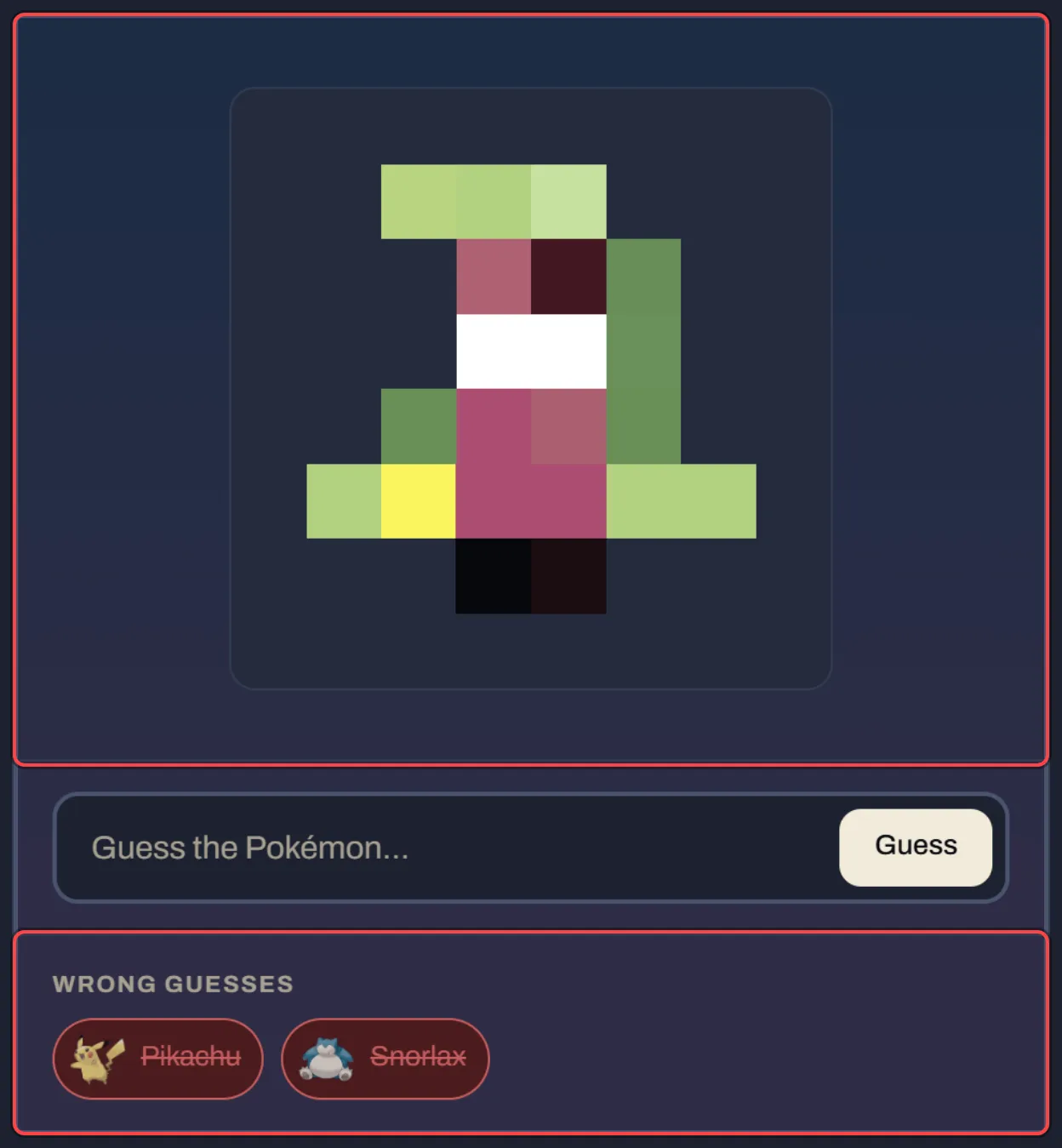
- Guess which Pokémon it is.
- Each miss makes the picture sharper, until you get it.
Pixel mode shows a Pokémon's official artwork shrunk to a few pixels per side and blown back up, so it opens as a grid of coloured blocks. Name the Pokémon. Every wrong guess adds resolution, and the picture keeps sharpening until you get it.
At the start there is no outline to speak of, only colour and where it sits. That makes it a different skill from a silhouette: you are recognising a palette, not a shape.
Reading the blocks
Look at the main colour first and at how much of the square it fills. One large block of a single colour points to a round, compact Pokémon; colour spread thin in a tall or wide strip points to a long or lanky one.
Then look for the accent. Most designs have one strong secondary colour, a belly, a flame, a shell, a mane, and its position in the grid often gives the Pokémon away before any edge does.
Ways in
- Colour usually follows type: blue for Water, green for Grass and Bug, red and orange for Fire, yellow for Electric, purple for Poison and Ghost. Start from the type the palette suggests.
- Evolution lines share a palette. If the colours say a family but not a stage, the amount of detail in the shape is your clue to size and stage.
- Step back from the screen or squint. Blurring your own eyes makes blocks read as a picture sooner than staring at them does.
- A wrong guess is not wasted: it buys a sharper image. If you have a plausible candidate, try it rather than waiting.
FAQ
How many attempts do I get?
As many as you need. Your score is the number of guesses it took.
Is it the same Pokémon as Silhouette today?
No. Each variant has its own daily Pokémon, picked from the date.
PokéPuzzles is an unofficial fan project, not affiliated with or endorsed by Nintendo, Creatures, GAME FREAK or The Pokémon Company. Pokémon and its character names are trademarks of Nintendo.