Weakness Mode
You get one Pokémon's damage-taken chart and nothing else: which types hit it for 4x, 2x, half, a quarter, or not at all. From that defensive fingerprint you have to name the Pokémon.
Start from the 4x entries, which only occur on dual types, and from the immunities, which are the rarest clue of all. A new chart goes up every day.
How to play
Weakness Mode
- The chart shows what each attacking type does to a hidden Pokémon, from ×4 down to immune.
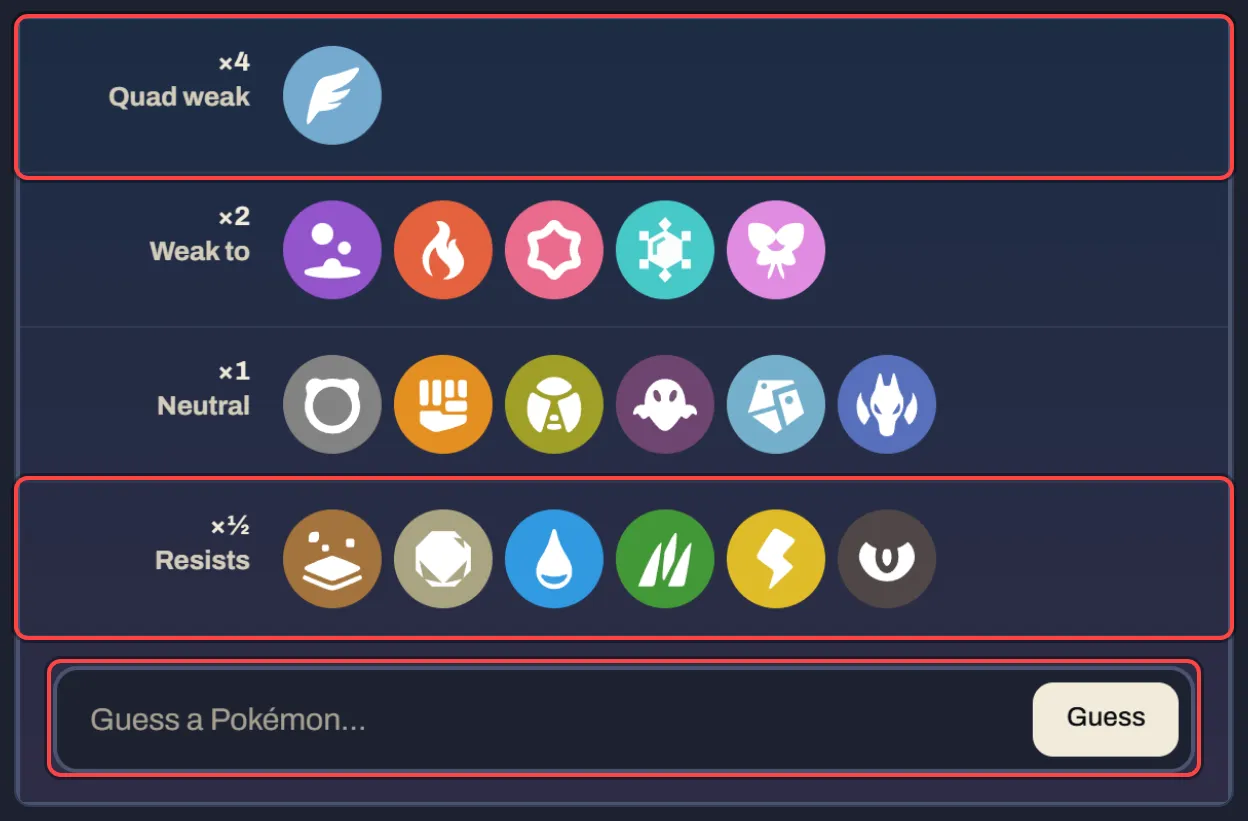
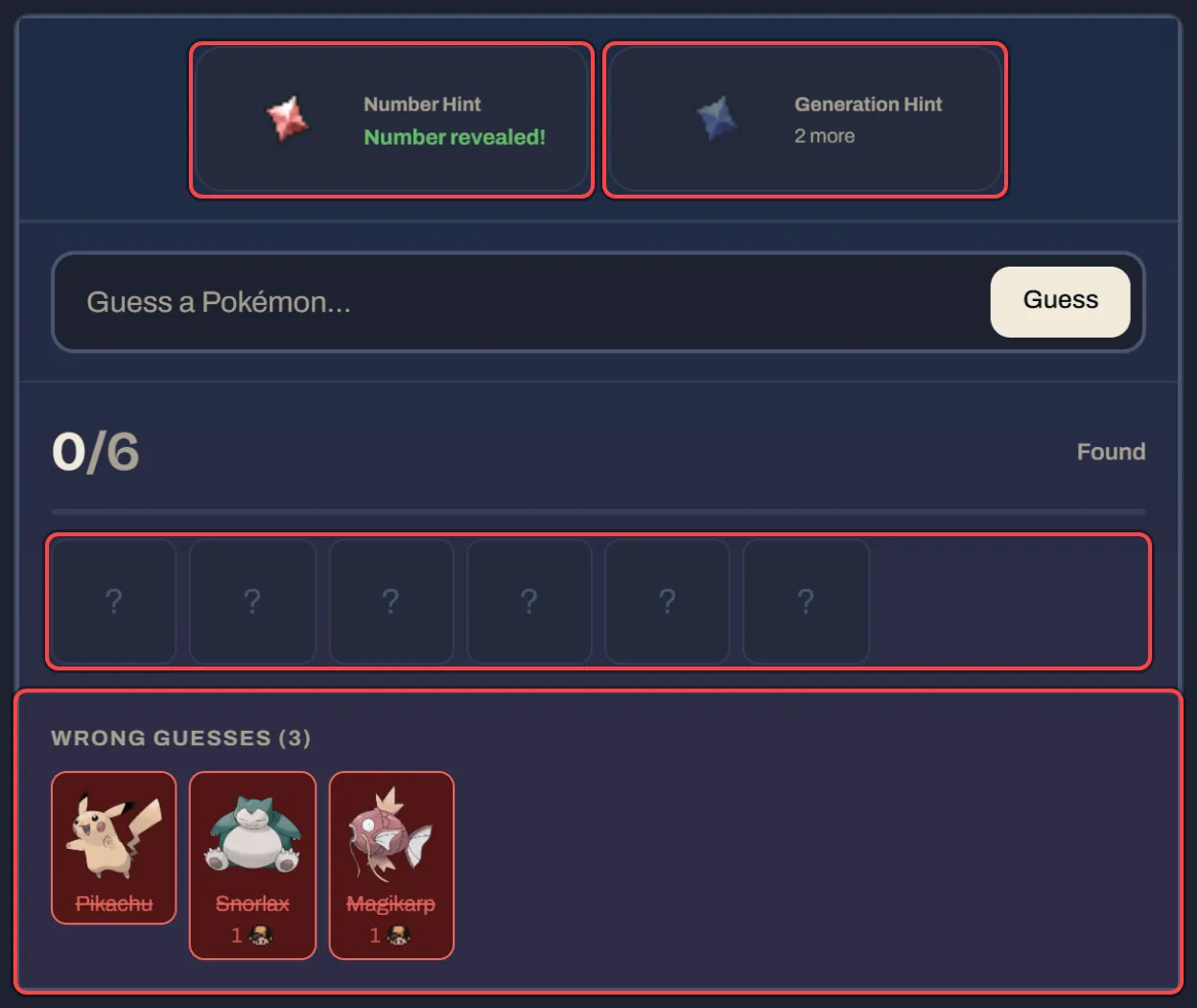
- Guess Pokémon with exactly that chart. Usually several share it: find them all.
- After three guesses you can reveal how many there are, and after five, their generations.
Weakness mode shows you a damage-taken chart and nothing else — no name, no sprite, no silhouette. Eighteen attacking types, each marked with what it would do to the hidden Pokémon: quadruple damage, double, normal, half, a quarter, or none at all. Your job is to name the Pokémon that chart belongs to.
It works because a defensive profile is close to a fingerprint. Type interactions multiply, so a dual type produces a pattern that very few other Pokémon reproduce exactly, and reading the extremes carefully usually cuts the field to a handful of candidates.
Reading the chart
A 4x entry can only come from a dual type where both halves are weak to the same attacking type — nothing single-typed ever reaches it. Spotting one immediately tells you the Pokémon has two types and tells you a great deal about which two.
A 0x entry is rarer still and even more decisive. There are only a few immunities in the game: Ground ignores Electric, Ghost ignores Normal and Fighting, Normal ignores Ghost, Steel ignores Poison, Dark ignores Psychic, and Fairy ignores Dragon. One zero on the board names a type outright.
The quarter-damage entries work the same way in reverse: both halves of the dual type resist the same attack. They are a strong confirmation once you have a theory, but they are harder to spot cold than a 4x.
Working it out
- Start at the extremes — 4x and 0x — and ignore the neutral column entirely. Everything at 1x is noise.
- Resistance to Grass, Water, Ground, Fighting and Bug all at once almost always means Poison or Steel is in the pair.
- Count the resistances. A chart with many of them points at Steel, which resists more types than anything else in the game.
- If nothing is 4x and nothing is 0x, consider a single type or a pair whose weaknesses cancel out — that absence is itself information.
- Once you have the type pair, the remaining work is not type theory but Pokédex recall: list what carries that combination and check the rest of the chart against each.
Common mistakes
- Reading the chart as damage dealt instead of damage taken. Every multiplier here is what the Pokémon suffers, never what it inflicts.
- Forgetting that an immunity beats a weakness. A type that is 0x against one half of the pair stays 0x no matter how weak the other half is.
- Assuming a 2x is a clean single weakness. It can also be a 4x cancelled down by a resistance on the other half.
Why it is worth learning
The chart in front of you is the same table that decides every battle in the main games, so the reasoning transfers directly. Players who work through this mode for a while stop looking type matchups up, because deriving a defensive profile from a type pair and recognising one from its shape are the same skill in both directions.
Type data comes from PokeAPI and the multipliers are computed ahead of time, so the chart you see is the product of the two type charts rather than anything we tuned by hand.
FAQ
Are alternate forms included?
The pool sticks to standard forms, so a regional variant will not be the answer to a chart that matches its ordinary counterpart.
Why do two Pokémon sometimes share a chart?
Defensive profiles depend only on the type pair, so same-typed Pokémon do share one. Only one of them is the day's answer, and a wrong-but-same-type guess is marked as such.
PokéPuzzles is an unofficial fan project, not affiliated with or endorsed by Nintendo, Creatures, GAME FREAK or The Pokémon Company. Pokémon and its character names are trademarks of Nintendo.